Why Texas Heat Is Quietly Wrecking Your Recovery (And What’s Actually Happening Inside Your Body)
If you’ve trained, played golf, or even just spent an afternoon outside in Central Texas this summer, you already know the heat hits different. But most people underestimate what’s actually happening inside their tissue when hydration slips — and it’s not just “feeling thirsty.” It’s a mechanical problem that affects how your muscles, joints, and spine function. Here’s what the research says, and what to actually do about it.
Your Spine Runs on Water — Literally
Most people think of hydration as a muscle and energy issue. It’s also a spine issue, and this is the part almost nobody talks about.
The discs between your vertebrae aren’t solid cushions — they’re closer to a water-based hydraulic system. The nucleus pulposus (the gel-like center of each disc) is made up of roughly 80% water, and the surrounding annulus fibrosus is close behind at around 70%. That water content is what gives your discs their cushioning ability and lets them resist the compressive load of standing, sitting, lifting, and moving throughout the day.
Water Content of a Healthy Spinal Disc
Here’s the mechanism: under load, your discs actually lose water — your spine compresses slightly throughout the day as fluid is pushed out of the disc tissue. When the pressure comes off (lying down, sleeping, decompressing), that water gets reabsorbed and the disc regains height and cushioning. It’s a real-time fluid exchange system, happening constantly, all day, every day.
Think of each disc like a sponge that’s load-bearing. Through the day, every step, every rep, every hour upright squeezes a little water out of the sponge — and your spine literally gets shorter by the evening. Overnight, when you’re unloaded and sleeping, the sponge soaks the water back up and the disc regains its height and cushion.
Now imagine trying to refill that sponge when the tap is barely running. That’s a dehydrated spine in Texas summer — less fluid available to reabsorb, less cushion restored, less margin for error under load.
When you’re dehydrated, there’s simply less water available for that system to work with. Less fluid to reabsorb means less disc height recovery, less cushioning, and a spine that’s working with less margin for error — especially under the kind of repetitive load that comes from training, sport, or a physically demanding job.
This is part of why summer often brings a noticeable uptick in stiffness and nagging back pain that doesn’t seem tied to any specific injury. It’s not always a new problem — sometimes it’s an old vulnerability getting less support from a system that’s running low on its most basic resource.
What Dehydration Does to Muscle Performance and Soreness
The muscle side of this is more commonly known, but the actual numbers are worth knowing.
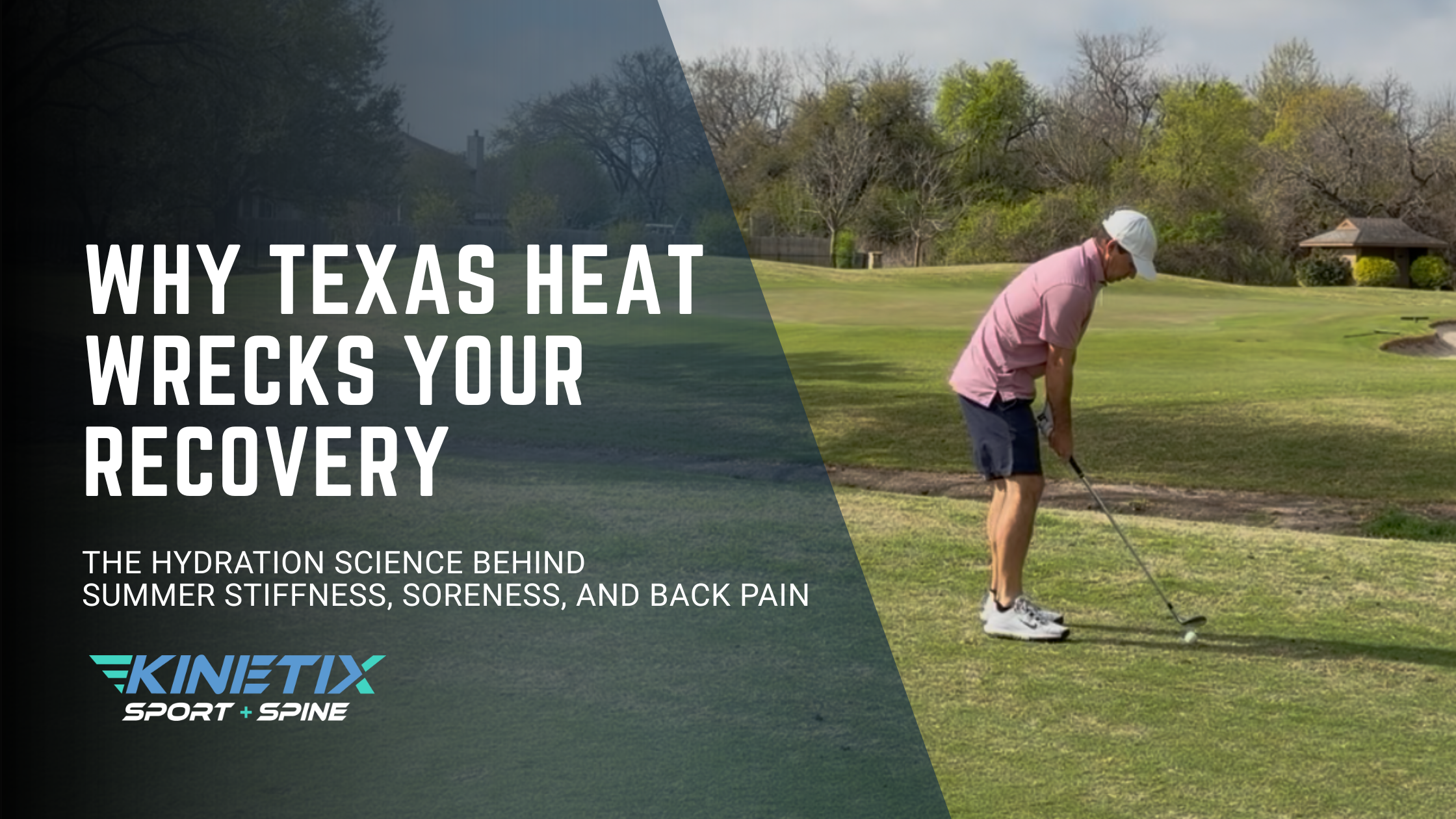
Research has found that athletes who start exercise already mildly dehydrated see measurable drops in strength, endurance, and both aerobic and anaerobic performance. This isn’t limited to obvious endurance sports either — motor-skill impairment from fluid loss has been documented in sports requiring precision and coordination, golf included.
Even a modest 2% loss in body mass from dehydration can increase your rate of perceived exertion by 8–10% — meaning the exact same workout or round of golf will simply feel harder when you’re under-hydrated, even before your performance numbers start to drop. You’re working harder to do the same thing, and you may not even realize why.
Then there’s recovery. Dehydration has been linked to an increased risk of delayed-onset muscle soreness (DOMS) following unfamiliar or intense activity — the kind of soreness that shows up a day or two later and lingers. Combined with reduced strength and endurance, this creates a window where you’re more vulnerable to additional strain or injury, simply because your tissue isn’t recovering as efficiently as it should.
And Then There’s Cramping
This is where the data gets genuinely useful, because it shows a clear dose-response relationship. In controlled research by Ohno and colleagues, progressive hypohydration steadily raised cramp susceptibility as fluid loss increased.
That’s a meaningful pattern — cramp risk doesn’t show up all at once, it climbs as fluid loss increases.
Worth noting: hydration isn’t the only factor at play. Muscle fatigue and neuromuscular control also influence cramp risk, so hydration is best understood as a major, modifiable risk factor — not the sole cause. But it’s one of the easiest variables to actually control, especially in Texas summer conditions where fluid loss through sweat can be significant even on a moderate-effort day.
What This Means Practically
You don’t need to overcomplicate this, but a few things matter more than people think:
-
Hydrate Before You’re Thirsty
Thirst is a lagging indicator — by the time you feel it, you’re already behind. Front-load your hydration before training or a round, not during.
-
Electrolytes Matter as Much as Water
Plain water without adequate sodium and electrolyte replacement can leave you under-hydrated at the cellular level even if you’re drinking plenty of fluid. In Texas heat, you’re losing electrolytes through sweat — refilling volume alone doesn’t replace them.
-
Recovery Days Are Rehydration Days
Your discs reabsorb fluid most effectively when you’re off your feet and unloaded — a good night’s sleep is doing more for your spine than you might realize. Rest isn’t just muscle recovery; it’s when your spine refills.
-
Rule Out Hydration Before Assuming Injury
If you’re feeling stiffer than usual this summer, hydration is worth ruling out before assuming it’s a new injury. The fix may be far simpler than you think.
Because electrolyte replacement matters as much as fluid volume in Texas heat, we recommend LivPür to our patients training or playing outside this summer. It’s built to replace what you’re actually losing through sweat — sodium and electrolytes — not just refill water volume. If you’re sweating through Central Texas summer training or golf, that distinction matters for how well your tissue actually recovers.
The Bottom Line
Heat doesn’t just make you tired — it changes how your tissue functions at a mechanical level, from your discs to your muscles. The good news is that hydration is one of the most controllable variables you have, and it’s worth taking seriously before issues compound, not after.
If summer training, golf, or just the Texas heat has you feeling stiffer or more sore than usual, that’s exactly the kind of thing we look at during a visit — figuring out what’s mechanical, what’s load-related, and what might simply be a hydration gap that’s easy to fix.
Feeling Stiffer This Summer?
Sometimes summer stiffness is mechanical, sometimes it’s load, and sometimes it’s a hydration gap that’s easy to fix. An assessment at Kinetix sorts out which. Same-week appointments in Spicewood.
Book an Assessment ?References
- Newell N, Little JP, Christou A, et al. Intervertebral disc structure and water content. In: Anatomy, Back, Intervertebral Discs. StatPearls. Confirms nucleus pulposus and annulus fibrosus water content of approximately 70–80% and the diurnal load/unload fluid-exchange mechanism. NCBI Bookshelf
- Bezci SE, Nandy A, O’Connell GD. Effect of hydration on healthy intervertebral disk mechanical stiffness. Journal of Biomechanical Engineering. 2015;137(10):101007. Demonstrates how disc hydration governs swelling and compressive stiffness. PubMed
- Maughan RJ, Shirreffs SM. Muscle cramping during exercise: causes, solutions, and questions remaining. Sports Medicine / GSSI Sports Science Exchange. Reviews Ohno et al. (2018): progressive hypohydration produced no exercise-associated muscle cramp at 1% body-mass loss, cramping in 3 of 9 subjects at 2%, and 6 of 9 at 3%. GSSI (PDF)
- Judelson DA, Maresh CM, Anderson JM, et al. Hydration and muscular performance: does fluid balance affect strength, power and high-intensity endurance? Sports Medicine. 2007;37(10):907-921. Documents reductions in strength, power, and endurance with hypohydration. PubMed
- Cheuvront SN, Kenefick RW. Dehydration: physiology, assessment, and performance effects. Comprehensive Physiology. 2014;4(1):257-285. Reviews how fluid loss of ~2% body mass raises perceived exertion and impairs aerobic and anaerobic performance. PubMed
This article is for general educational purposes and does not constitute medical advice. Individual hydration needs vary.