
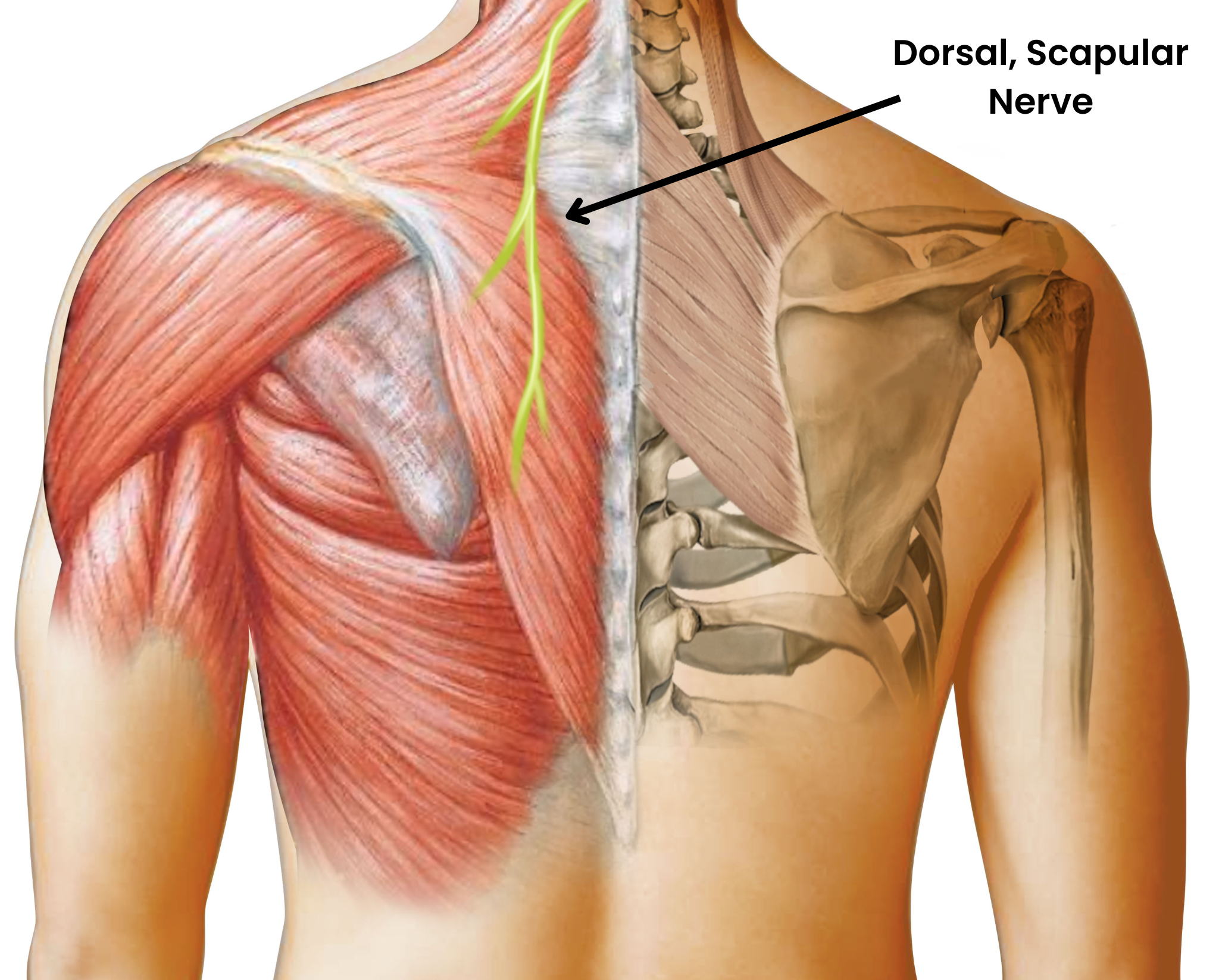
If you’ve ever experienced deep, nagging pain along the medial (inside) border of your shoulder blade, it could be more than just a muscle knot. Dorsal scapular nerve entrapment is a common but overlooked cause of shoulder blade pain, tightness, and dysfunction.
This condition is especially common in people with poor posture, desk jobs, athletes, and weightlifters, where tight upper traps, levator scapulae, and rhomboid muscles compress the dorsal scapular nerve, leading to pain, restricted movement, and weakness.
At Kinetix Sport & Spine, we specialize in soft tissue therapy for nerve entrapments, ensuring precise treatment to release adhesions, restore mobility, and eliminate pain at the source.
Table of Contents | Dorsal Scapular Nerve Entrapment
What Is the Dorsal Scapular Nerve?
The dorsal scapular nerve (DSN) is a small but powerful nerve that runs behind the upper trapezius and travels down the medial border of the scapula, innervating the:
✅ Rhomboid major (stabilizes and retracts the scapula)
✅ Rhomboid minor (assists in scapular retraction and elevation)
Since these muscles are critical stabilizers of the shoulder blade, dorsal scapular nerve entrapment can cause pain, tightness, and dysfunction throughout the upper back and shoulders.
What Causes Dorsal Scapular Nerve Entrapment?
Nerve entrapment occurs when the dorsal scapular nerve gets compressed between or within tight, overactive muscles. The most common causes include:
1. Forward Head & Rounded Shoulder Posture
Poor posture (especially from sitting at a desk) causes excessive strain on the rhomboids, levator scap, and upper traps, leading to muscle adhesions that trap the nerve.
2. Overuse & Muscle Tightness from Stress
Chronic muscle tension from stress, repetitive overhead movements, or improper lifting techniques can cause muscle fibers to tighten and compress the nerve.
3. Weak Scapular Stability & Imbalances
When the rhomboids and lower traps are weak, the upper traps and levator scapulae become overactive, pulling the scapula into dysfunction and trapping the dorsal scapular nerve.
4. Adhesions & Fascial Restrictions
Adhesions in the fascia surrounding the nerve cause the dorsal scapular nerve to become glued down, limiting movement and creating chronic nerve irritation.
Symptoms of Dorsal Scapular Nerve Entrapment
This nerve compression can mimic muscle knots, but true entrapment leads to nerve-related symptoms, including:
❌ Deep, aching pain along the medial border of the scapula
❌ Pain that worsens with prolonged sitting, desk work, or overhead activities
❌ Difficulty retracting or stabilizing the shoulder blade
❌ A sensation of “stiffness” or “glued down” muscles
❌ Pain that radiates from the upper traps down to the mid-back
If you feel tightness that doesn’t go away with stretching, your dorsal scapular nerve may be trapped within adhesions in the soft tissue.
Why Soft Tissue Therapy is KING for Dorsal Scapular Nerve Entrapment
Most traditional treatments focus on stretching or basic strengthening, but this doesn’t address the root cause: nerve entrapment from adhesions and tight fascia.
At Kinetix Sport & Spine, we use advanced soft tissue therapy to release the dorsal scapular nerve, eliminate adhesions, and restore proper function.
Our Targeted Soft Tissue Approach
1. Active Release Techniques (ART) for Specific Adhesion Release
ART is the gold standard for breaking up adhesions in the rhomboids, levator scap, and upper traps. This frees up the dorsal scapular nerve, restoring movement without restriction.
2. Instrument-Assisted Soft Tissue Mobilization (IASTM) for Myofascial Release
We use IASTM tools to break down scar tissue and improve fascial glide, reducing nerve irritation.
3. Nerve Flossing & Mobilization
By guiding the nerve through specific movement drills, we can restore normal nerve function and prevent re-entrapment.
4. Cupping Therapy for Decompression
Cupping therapy helps lift and separate tissue layers, allowing the nerve to move freely again.
5. Corrective Exercises to Rebalance Scapular Stability
Once the nerve is freed, we implement exercises that restore proper scapular movement and prevent further compression:
✅ Scapular retractions (to strengthen the rhomboids)
✅ Wall slides & serratus activation (to correct scapular positioning)
✅ Upper trap & levator scap stretches (to maintain soft tissue mobility)
Why Chiropractic Care for Dorsal Scapular Nerve Entrapment?
At Kinetix Sport & Spine, we don’t just focus on the symptoms—we address the root cause of nerve entrapment through precision soft tissue therapy. Our approach provides:
✔️ Fast pain relief with targeted nerve release
✔️ Improved mobility by restoring muscle and nerve function
✔️ Long-term results by eliminating compensatory patterns
Take Control of Your Shoulder Blade Pain Today!
If you’ve been dealing with nagging shoulder blade pain that won’t go away, it’s time to address the dorsal scapular nerve entrapment at the source.
Schedule Your Soft Tissue Therapy in Austin Today!
🔹 📅 Book Online: Click Here
🔹 📍 Visit Us: Kinetix Sport & Spine – Austin, TX
🔹 📞 Call Now: 512-730-0284
Stop wasting time on temporary fixes—get real, lasting relief today!

