
Table of Contents | Golfing with Golfer’s Elbow
Understanding Golfer’s Elbow vs. Tennis Elbow
Golfing with golfer’s elbow can be frustrating, but understanding the root cause and proper treatment can keep you on the course pain-free. Golfer’s elbow, also known as medial epicondylitis, is a condition characterized by pain and inflammation on the inner side of the elbow, where the tendons of the forearm attach to the medial epicondyle of the humerus. It is primarily caused by repetitive stress, improper mechanics, and overuse of the flexor muscles of the forearm. In contrast, tennis elbow (lateral epicondylitis) affects the outer side of the elbow due to excessive strain on the extensor muscles.
Interestingly, the prevalence of these conditions differs between amateur and professional golfers. Among amateurs, tennis elbow is significantly more common in the lead arm, occurring at a ratio of 5:1 compared to golfer’s elbow in the trail arm. However, this trend reverses in professional golfers, who experience golfer’s elbow more frequently in their lead arm due to their refined swing mechanics and the increased stress placed on the medial side of the elbow.
Swing Modifications to Prevent and Cure Golfer’s Elbow
Elbow pain in golfers often stems from improper swing mechanics that place excessive strain on the upper extremities, in this case the elbows . Below are some of the most common swing faults associated with golfer’s elbow and how to modify them to prevent or alleviate pain.
1. Poor Use of the Lower Body
Fault: Many golfers believe elbow pain is purely an upper-body issue, but in reality, poor lower-body engagement forces the upper body to overcompensate, leading to excess strain on the elbows.
Modifications:
- Ensure proper weight shift from the trail side to the lead side during the downswing.
- Avoid early extension, which pushes the hips forward and forces the upper body to lift, increasing elbow strain.
- Address core stability and hip mobility to maintain efficient lower-body movement.
2. Chicken Winging
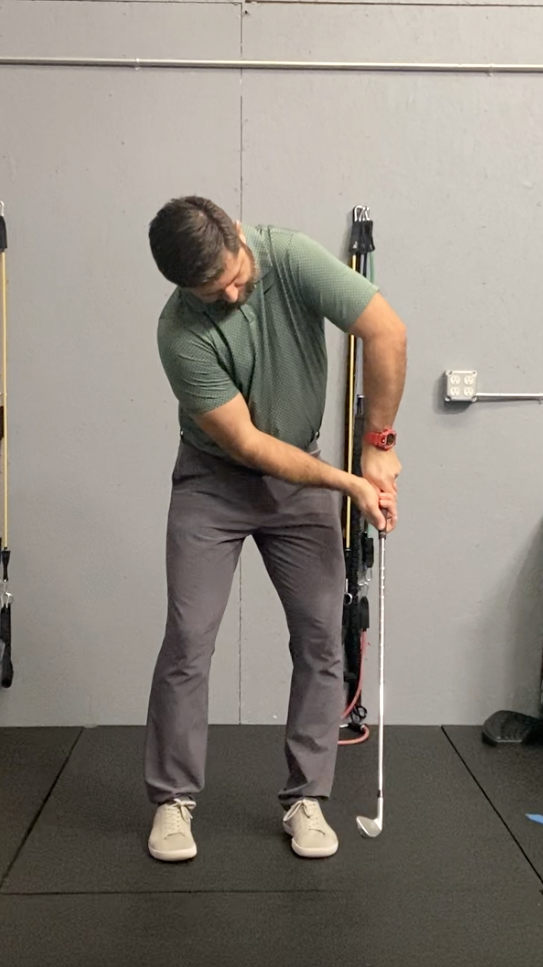
Fault: This occurs when the lead elbow remains bent through impact instead of fully extending, causing excessive stress on the elbow tendons.
Modifications:
- Work on maintaining proper extension through impact by improving shoulder mobility and stability.
- Strengthen the core to reduce upper-body compensations.
- Improve trail-arm activation to promote a smoother release.
3. Over-the-Top Motion
Fault: An excessive upper-body downswing causes the club to move outside the normal swing plane, creating a steep, forceful impact that strains the elbow.
Modifications:
- Improve hip rotation mobility to allow for a smoother transition.
- Focus on a proper weight shift rather than initiating the downswing with the arms.
- Strengthen shoulder external rotation to maintain proper club path.
4. Casting
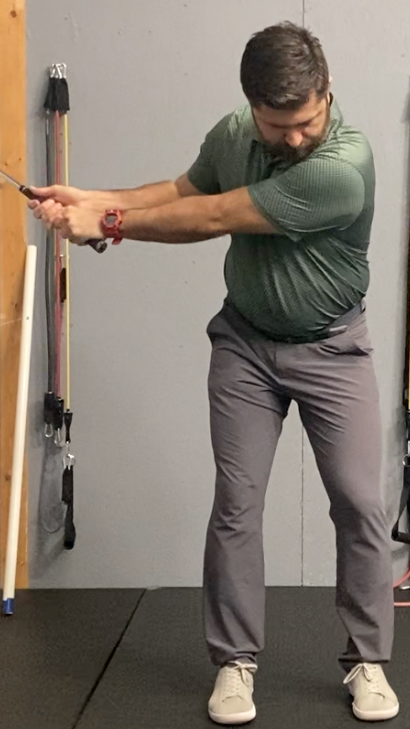
Fault: Also known as an early release, casting occurs when the wrists lose their angle too soon in the downswing, shifting excessive force to the forearm flexors and leading to golfer’s elbow.
Modifications:
- Strengthen grip and forearm muscles to maintain lag in the swing.
- Improve wrist and forearm stability to resist premature extension.
- Use drills that encourage proper lag retention through impact.
5. Hitting Off Hard Surfaces
Fault: Repeatedly striking from hard surfaces, such as synthetic driving range mats or firm turf, can lead to excessive shock absorption through the elbows.
Modifications:
- Limit full-swing practice from mats and opt for real turf when possible.
- Use a tee for long irons and hybrids to reduce impact force.
- Incorporate recovery strategies such as stretching, massage, and proper hydration.
6. Fat Divots
Fault: Taking excessively deep divots places abrupt stress on the elbows, leading to inflammation and microtrauma in the tendons.
Modifications:
- Work on shifting the low point of the swing forward to ensure clean ball-first contact.
- Address weight shift issues that cause a shallow or steep angle of attack.
- Use properly fitted clubs to optimize lie angle and length.
7. Sudden Increase in Practice Volume
Fault: A rapid increase in playing time or practice intensity without proper conditioning can overload the forearm muscles and lead to golfer’s elbow.
Modifications:
- Gradually increase swing volume to allow for muscle adaptation.
- Implement recovery techniques such as stretching and strengthening exercises.
- Ensure proper grip technique to minimize excessive strain.
8. Grip Alterations
Fault: Changing grip size or pressure can place undue stress on the flexor and extensor tendons, contributing to golfer’s elbow.
Modifications:
- Work with a professional to determine an optimal grip size that reduces excess strain.
- Maintain a relaxed yet firm grip to prevent excessive forearm tension.
- Strengthen the intrinsic hand and forearm muscles for better endurance.
Strength and Recovery Strategies for Curing Golfer’s Elbow
To prevent and recover from golfer’s elbow, incorporate exercises that enhance forearm endurance and resilience:
- Wrist Flexor and Extensor Strengthening: Use resistance bands or light dumbbells to perform wrist curls and extensions.
- Eccentric Loading: Slowly lower weights during wrist flexion to promote tendon healing.
- Grip Strength Training: Use grip trainers or stress balls to build hand and forearm endurance.
- Shoulder Stability Work: Strengthen the rotator cuff and scapular stabilizers to reduce excessive arm strain.
Stretching and Mobility Work
- Forearm Flexor Stretch: Extend your arm with the palm facing up and gently pull back on the fingers.
- Forearm Extensor Stretch: With the palm facing down, gently pull back on the fingers to stretch the extensor muscles.
- Thoracic Mobility Drills: Improve spinal rotation to reduce compensatory stress on the arms.
- Shoulder Range of Motion Drills: Improve your shoulder’s range of motion to reduce stress into the elbows.
- Hip and Core Mobility Work: Enhance lower-body efficiency to minimize upper-body compensation.
Recovery Strategies
- Soft Tissue Therapy: Use Active Release Techniques (ART) to break up adhesions in the forearm and elbow.
- Compression and Ice Therapy: Apply compression sleeves and ice post-practice to reduce inflammation only immediately after practice sessions or rounds. Lateral in the night, utilize heat in place of ice.
- Massage and Myofascial Release: Utilize self-massage tools, or a stretching routine to release tension in the forearm muscles.
- Nutrition and Hydration: Ensure proper electrolyte balance and protein intake to support tendon repair.
Conclusion
Golfer’s elbow is a common yet preventable condition that arises from improper mechanics, overuse, and compensatory movement patterns. Curing golfer’s elbow takes time, but with the right approach, you can continue golfing with golfer’s elbow while minimizing pain and preventing further injury.
Understanding the differences between golfer’s elbow and tennis elbow, recognizing how swing mechanics contribute to elbow stress, and implementing corrective modifications can help prevent and cure golfer’s elbow. By integrating proper strength training, recovery strategies, and optimized swing mechanics, golfers can protect their elbows and enhance performance on the course.
If you’re struggling with persistent elbow pain, book an appointment at Kinetix Sport and Spine to get a full-body assessment and a tailored treatment plan. Visit KinetixATX.com or call 512-730-0284 to schedule your appointment today.